When the Render Looked Finished and the Film Wasn't: Our Month With AI Storyboards
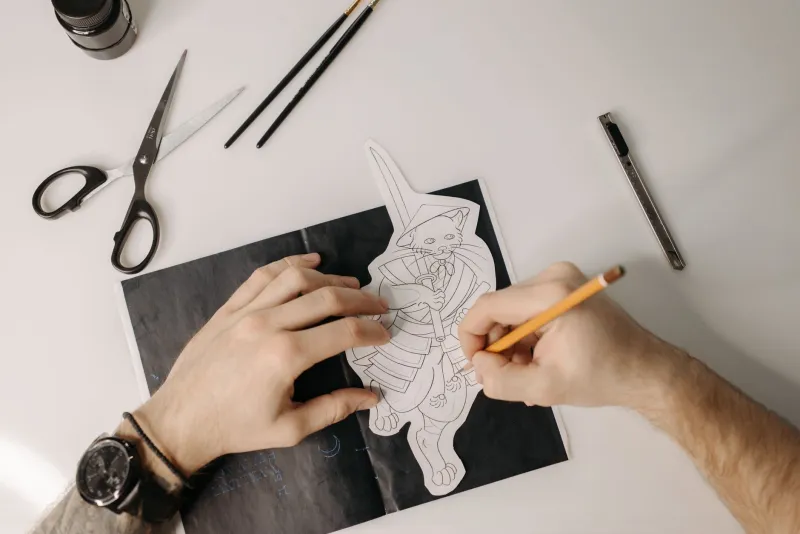
Photo: paper storyboard sketches on desk with pencils and coffee, via bookbinding-techniques.topicbarn.com
Earlier this year, we decided to give AI storyboards a fair go. Not a novelty afternoon, not a LinkedIn experiment — a proper month inside live work at Redcat Studios. We had client pitches, a documentary treatment, a short brand film and a two-day shoot to plan. The promise was obvious: type a scene, get an image, save time and money. We wanted to know whether that promise survived contact with actual production.
The experiment
We used two tools and rotated them across different jobs. This is not a review of specific software; the market changes too fast. The routine was simple. For each scene we wrote a prompt, generated a handful of options, then compared the results with our usual paper boards. We kept a tally of time saved and notes on what changed in the room. We did not tell clients AI was involved unless they asked. We wanted to see if it changed the conversation.
Where AI actually helped
It was genuinely useful for mood. If a client could not picture 'warm but not cosy' or 'documentary, not corporate', we could generate a few frames and say 'closer to this, further from that'. That is faster than digging through reference folders. It also helped with boring coverage. Wide, medium, close-up, cutaway, insert — AI gave us a visual checklist when our brains were fried after a long recce.
There was one pitch where it saved us a day. A client in Bristol wanted a film with a very specific look: overcast coast, faded paint, no obvious gloss. We generated a page of references in an hour, picked the three that felt right, and built the treatment around them. The client signed off the mood quickly. That was a real win, and we should say so.
What got lost in the render
But AI storyboards have a house style. Everything comes back a bit glossy, a bit cinematic, a bit like a streaming service thumbnail. The people look like they have been lit by a small sun. The rooms look expensive. The weather looks Californian. Our actual shoot was in a community hall in Sheffield with a tea urn and a window that faced a car park. The AI board looked like a perfume ad. That gap is not just aesthetic; it is a planning risk.
Paper boards are ugly in a useful way. A stick figure tells the crew where to stand. An arrow tells the camera where to move. A scribbled note in the margin — 'do not let the boiler hum' — is a message to the sound recordist. AI images are too finished to argue with. They invite clients to comment on furniture, not blocking. They look like the film is already made, which makes it harder to change.
The paper ritual
We went back to paper not because we are nostalgic. We went back because paper is a collaborative shorthand. At a recce, you can draw over a printed floor plan while three people talk at once. A client can add a note. A crew member can correct your camera position with a biro. The board becomes a record of the conversation. AI gives you a result. Paper gives you a meeting.
Also, paper is fast in the right hands. A rough eight-panel sequence takes about twenty minutes. An AI prompt takes twenty minutes plus selection, regeneration, export, and a discussion about why the software put a piano in the kitchen. The speed advantage flips depending on how many people need to understand the frame.
The cost question
Subscription cost is not the whole cost. There is the time spent prompting, curating, fixing weird hands and explaining why the lighting in the image is not the lighting we can afford. For small UK studios, cost saving matters, but so does client trust. A hand-drawn board says we have thought about your budget. A glossy AI board can imply a level of production you cannot deliver. That is a dangerous promise to make in a pitch.
Our verdict: a tool in the bag, not the bag
We still use AI for mood boards, lighting references and internal exploration. We do not use it for the boards we take into a pitch unless the client asks. The month taught us that storyboards are not pictures of the film. They are a conversation about the film. Paper still wins that conversation. The sketchbook is back on the desk, the pencils are sharpened, and the AI tab is open in the background — where it belongs.