The Tea Urn Will See You Now: Notes From a Village Hall Screening Tour
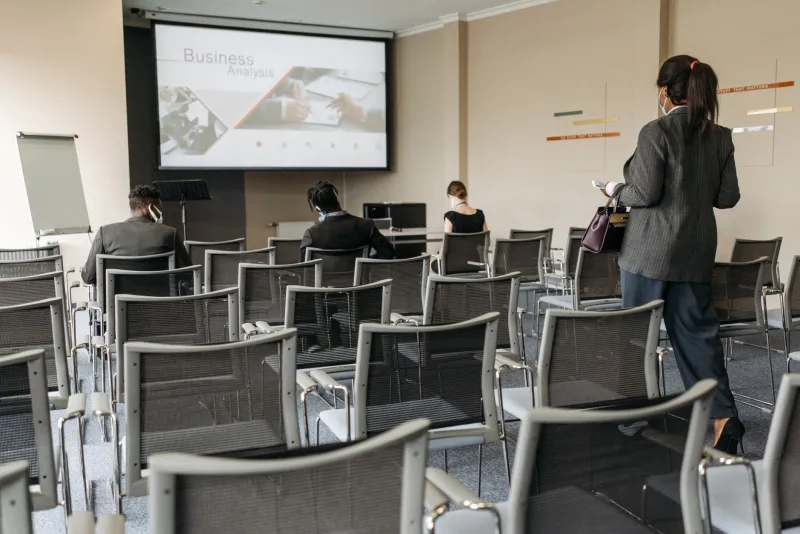
Festival screenings are lovely. The seats are raked, the projector is hidden, and nobody asks whether the film can be paused while the urn boils. But a short film doesn’t only live in a festival slot. This autumn we took one of our Redcat shorts out to village halls, church rooms and a library meeting space — the kind of places where the screen is a pull-down job and the front row is a stack of chairs from the cupboard under the stairs.
We called it a tour because it sounded better than “driving a hard drive around the North”. In practice it was three screenings, one borrowed projector, a roll of gaffer tape, and a growing respect for the people who run these rooms.
The room sets the rules
A cinema gives you a known throw distance, a fixed screen and seats that face the right way. A village hall gives you a stage that is also a badminton court, a screen that curls at the bottom, and a window that somebody insists on opening because the heating is “a bit fierce”.
We learned to arrive two hours early. Not to be precious, but because projector throw is a physical fact. You can’t argue with it. We measured the distance from the back wall to the screen, worked out whether the borrowed projector could fill the frame without being zoomed into a blurry mess, and then moved the chairs to fit the picture rather than the other way round.
The first hall had a beautiful high ceiling and a screen that sat far too low. We ended up raising it with two coat hooks and a length of para cord. It looked like a repair café project, but it worked. The lesson was simple: bring tape, cable ties, a spare HDMI lead and a small torch. Most of all, bring someone who is happy to stand on a chair and squint at a test card while everyone else puts the kettle on.
Daylight is a scene-stealer
British daylight does not respect your contrast ratio. Our short has a few dark interior scenes, and in a room with thin curtains and a low afternoon sun, they turned into a rumour of a scene. We carried a blackout cloth, which sounds grand and is really just a large piece of dark fabric, but it made the difference between people watching the film and people watching their own reflections in the window.
Evening screenings were easier, but only just. Village halls have a way of keeping a bit of light in the room — a fire exit sign, a gap under the door, a kitchen hatch that glows like a small moon. We stopped trying to make it perfect. The aim was legibility: faces readable, subtitles readable, the mood intact. If you are touring a short, test the darkest and brightest scenes in the actual room. Your edit suite is not the venue.
Sound in a room with a kitchen hatch
Our mix was built for headphones and a decent cinema system. The village hall had hard floors, a high ceiling, and a fridge humming somewhere behind a hatch. The first run-through sounded like the film was being played inside a biscuit tin.
We moved the speakers forward, angled them slightly in, and kept them off the floor. We also lowered the bass a touch and raised the dialogue. Not ideal, not permanent, but practical. The biggest surprise was how much the room added. A quiet scene that felt tense in the edit became almost inaudible when someone opened the kitchen hatch to check on the tea. We ended up putting a small sign on the hatch: “Please close gently during the film.” It worked better than any technical fix.
If you are screening outside a cinema, ask about the kitchen hatch, the fridge, the heating and the clock. Especially the clock. One hall had a clock that chimed every quarter hour. We didn’t notice until the second screening. Now we notice.
The tea break is the interval
At a festival, the film ends and there is a polite pause before the next thing. In a village hall, the film ends and someone says, “Right, tea?” That is not a failure of attention. It is the social contract of the room.
We built the screening around it. A short block of films, then the urn, then the Q&A. The tea break gave people permission to talk about what they had just seen without the pressure of a formal discussion. We heard more honest reactions over a custard cream than we ever have in a festival bar. One woman told us the kitchen in the film looked exactly like her aunt’s. Another asked why the main character didn’t just get the bus. That question was more useful than it sounds — it told us the geography hadn’t landed.
The Q&A is better when nobody is being polite
Festival Q&As can be lovely, but they are often a gentle round of nods. A village hall Q&A is different. People ask about the kettle, the location, the dog, the cost of the van. They ask because they are not trying to place you in an industry. They are trying to place the film in their own lives.
After one screening, a man asked whether the sound of the door slamming was real or added. It was added. He said it sounded like his back door, which was exactly the effect we wanted. That was a better note than any panel feedback we’ve had this year. It was specific, domestic and completely free of posturing.
What we would change next time
We would carry a backup projector, even a cheap one. We would print the running order in large type and tape it to the door. We would ask about the heating before we ask about the Wi-Fi. And we would stop thinking of the tea break as something to get through. It is the bit where the room becomes a room.
The village hall is not a cinema. The seats are not raked, the screen is not perfect, and the interval comes with a kettle. But the audience is right there — close enough to tell you what they actually saw. That is worth more than a polite nod in a darkened festival tent.