No Second Chances: Shooting Behind-the-Scenes Stills on 35mm
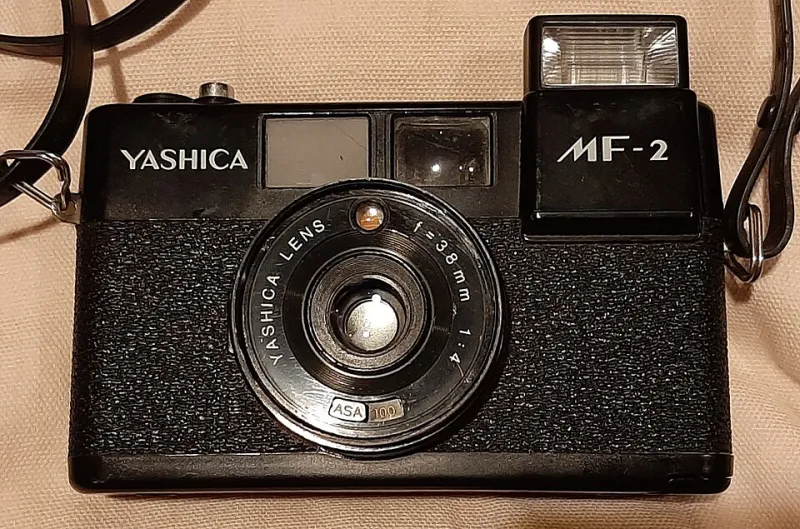
Photo: Sgroey, CC BY-SA 4.0, via Wikimedia Commons
On a wet Tuesday in October, we started shooting a short film in a community hall in West Yorkshire. Alongside the usual kit — a digital camera, a monitor, a tangle of cables — we packed a 35mm film camera and a bag of rolls. The plan was simple: all behind-the-scenes stills would be shot on film. No digital safety net. Thirty-six frames per roll. That's it.
It sounds like a gimmick. It wasn't. It changed how we watched our own set.
Why We Left the Digital Camera at Home
The decision came from a place of mild frustration. Digital BTS photography is brilliant and endless. You can fire off hundreds of frames, review them on the back of the camera, and promise yourself you'll sort them later. You rarely do. The images become a chore, a folder of 1,200 files named DSC_ something.
Film gives you a natural limit. Thirty-six exposures per roll. You can carry five rolls, but you still have to justify every click. That forces you to think like a documentary photographer rather than a set visitor with a camera. You watch more. You wait. You decide what actually matters.
Loading Film in a Hallway With a Cup of Tea
Practicality is where the romance meets the lino. Loading a 35mm camera on a busy set is not glamorous. You need a flat surface, a bit of shade, and a moment when nobody needs you. We used the corridor outside the kitchen, next to a stack of folding chairs and a tea urn that never stopped. The ritual of loading — opening the back, threading the leader, closing the door, advancing to the first frame — became a small pause in the day. It slowed us down in the best way.
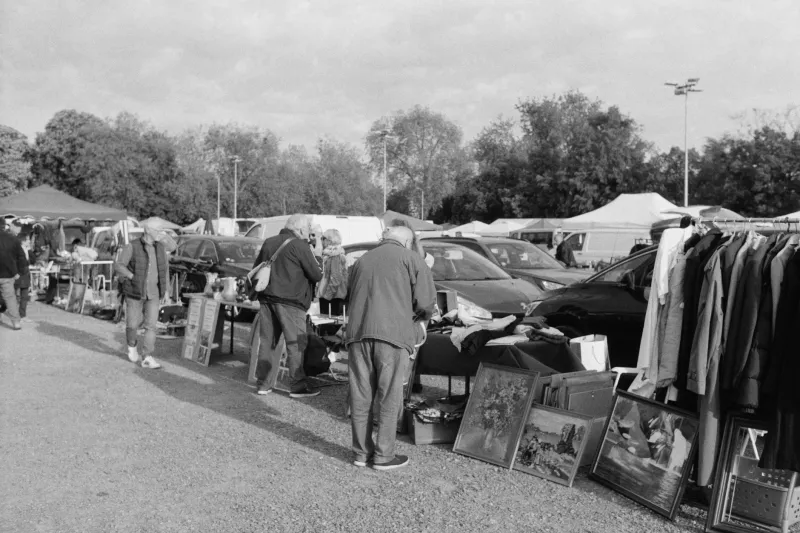
We shot black and white (Ilford HP5) for most of the day, with a roll of colour for the evening scenes. The light in the hall was a mix of tungsten and the grey stuff coming through the windows. On digital, you'd fix that later. On film, you lean into it. The grain sits in the shadows. The contrast goes soft. It looks like the day felt.
The Frame Budget: What Gets Shot and What Doesn't
Thirty-six frames doesn't go far when there are twelve people on set. We made a rule: no more than two frames per 'moment'. That meant choosing the moment carefully. The gaffer taping a cable to the floor? Maybe. The director laughing at a prop that refused to behave? Almost certainly. The back of someone's head during a take? Only if the light was doing something interesting.
The result is a set of images that feel considered. There's no machine-gunning. There's no 'we'll fix it in the edit'. Each frame has a reason to exist. The contact sheet becomes the storyboard after the fact — a sequence of decisions rather than accidents.
The Grain Is the Point
We're not anti-digital. We use digital cameras every day. But there is a texture to 35mm that suits BTS photography. It feels like a memory of the shoot, not a record. The grain softens the edges of a room that was actually quite ugly. It makes the crew look like they're in a film about making a film. That's not a bad thing.
The colour roll was the surprise. Under the hall's fluorescent strips, skin tones went slightly green on digital. On film, they went warm and forgiving. The red of a prop mug popped. The blue of a crew hoodie stayed put. None of it was accurate, but all of it was right.
What We Learned About Our Own Set
Shooting on film made us better observers. When you can't check the back of the camera, you have to trust your eye. You have to watch the room, not the screen. You notice the way the boom operator holds a cup of tea like it's part of the kit. You notice the runner's trainers. You notice the light moving across the floor as the afternoon goes on.
It also made the crew more curious. People asked what film we were using. They wanted to know if the shots would come out. There's a slight tension to shooting on a medium that doesn't forgive. It made the day feel like an event. When the rolls went to the lab, we had to wait. That wait was lovely. It gave the images time to settle.
The Contact Sheet in the Drawer
We got the scans back a week later. Not all of them worked. A few frames were soft. One roll had a light leak. But the ones that did work felt like the truth of the day: the kettle, the gaffer, the director's hand mid-gesture, the grey Yorkshire sky through a fire door. The contact sheet sits in a drawer now. It's not a file. It's an object. It has a weight.
Would we do it again? Yes. But not every shoot. The constraint is the point, and if you make it a habit, it stops being a constraint. For this film, on this day, thirty-six frames were enough. They had to be.