Before the Tarpaulins Go Up: Photographing a Car Boot Sale as a Temporary Town
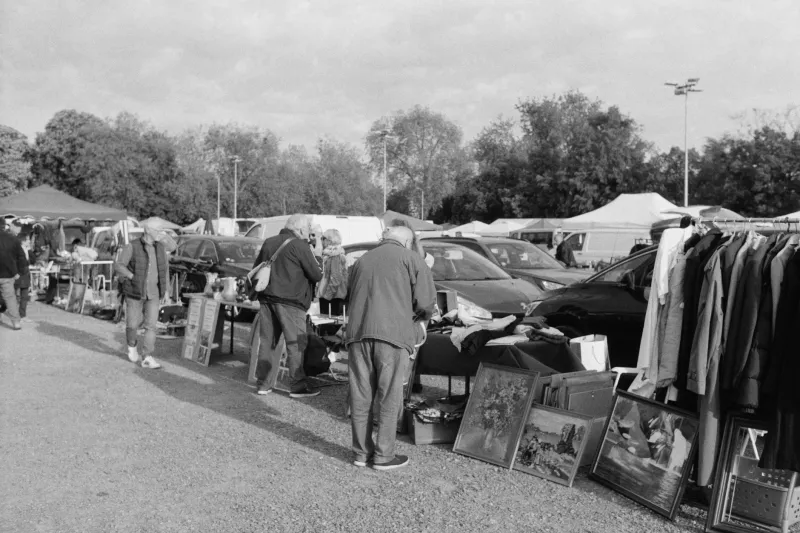
There is a moment, around ten past six on a Sunday morning, when a car boot sale does not look like a car boot sale at all. It looks like a field with ideas. A man in a fleece is walking a line of cones. A van door clicks open. Somewhere near the gate, a woman is unrolling a groundsheet with the concentration of someone laying a carpet in a stately home. By seven, the whole thing will be a town. By one, it will be a field again.
We went along earlier this year with cameras and a vague plan to photograph the stuff. We came back with something closer to a study of temporary planning: how people claim space, build shelter, arrange goods and create a high street out of trestle tables and bungee cords. It was documentary photography, but it was also set design research. A car boot sale is a film set that builds itself, then dismantles before lunch.
The 7am Municipality
The first thing that strikes you is the order. Not official order, necessarily — though the organiser with the clipboard and the high-vis is doing heroic work — but the private order of sellers. Each pitch has a logic. Clothes go on a rail because clothes on a groundsheet look like a rummage, and a rummage is a harder sell. Tools go flat and heavy at the front. DVDs go in a crate, spine up, because blokes in fleeces will crouch and read them like a library shelf.
The architecture is brilliantly improvised. Gazebos lean into the wind. Tarpaulins are tied to car roofs with washing line. A crate becomes a step, a shelf, a seat. Someone has brought a pasting table and turned it into a display case for china teacups. Someone else has hung a mirror from a broom handle so customers can check a jacket. None of it is precious, and all of it is deliberate.
The light does half the work. Low sun across a field gives you long shadows, backlit steam from the brew van, and a soft grey wash on anything under a canvas roof. We shot wide frames to show the layout, then moved closer for the details that make a place feel real: gaffer tape on a table edge, a handwritten price sign, a flask balanced on a bumper.
Asking First, Buying Second
Photographing a market full of bargain hunters needs care. People are there to buy a microwave or sell a bike, not to be part of a project. We emailed the organiser beforehand, turned up early, introduced ourselves and asked where we could stand without being in the way. Then we did the same with sellers, one pitch at a time. If someone said no, we moved on. If someone asked what it was for, we told them: a small printed zine, possibly some set reference for future shoots, nothing that would make them look like a punchline.
Buying something helped. Not as a transaction for access — nobody owes you a portrait because you bought a mug — but because it slowed us down and gave us a reason to talk. We came home with a wooden plane, two enamel plates and a book about ponds. The enamel plates are now in the studio kitchen. The pond book is still on my desk.
We avoided photographing people in ways that felt mocking. No tight crops of someone counting coins, no sneaky frames of a argument over a fiver. If a face was going to be recognisable, we asked. The result is a set of images that feels busy but not invasive: hands, backs, shoulders, the occasional direct look from someone who was happy to be in the frame.
Kit, Compromises and Cold Fingers
We kept it simple. A Fujifilm X-T2 with a 23mm f/2 did most of the digital work, and a Pentax ME Super with a 50mm f/1.7 came out for the slower stuff on Portra 400. No flash. Flash at a car boot sale makes everything look like a police evidence photo, and it kills the early-morning atmosphere. Overcast skies are your friend; direct sun is harder, but it gives you the long shadows and the dust in the air.
We shot at f/5.6 for the wide scenes so the makeshift architecture stayed readable, and opened up for portraits. A monopod was useful in the crowd. A pocket full of spare batteries was more useful. The main compromise was time: by nine, the place was heaving, and the quiet layouts of 7am had gone. If we do it again, we will arrive even earlier and stay for the pack-down. The end of a market is its own kind of documentary.
The Zine That Became a Set Bible
We printed the photographs as a 32-page A5 zine. It was photocopied in black and white with one spot colour on the cover, saddle-stitched, and priced at £4. Cheap enough to give away to the organiser and a few of the sellers who had let us photograph them. The images were grouped like a day: arrival, architecture, trade, departure. It was never meant to be a portfolio piece. It was meant to be a object you could put in a pocket.
Then something useful happened. We started using it as a visual reference for film sets. The zine sits on the shelf next to our mood boards now, and when we need to dress a scene that feels lived-in and British and a bit improvised, we open it. There is a texture to a car boot sale that is hard to fake: the specific grey of a tarpaulin, the way a cardboard box sags when it has been rained on, the colour of a plastic crate that has spent ten years in a garage. Production designers talk about "realism", but often what they mean is "evidence of use". A car boot sale is evidence of use in every frame.
What We Learned
A few things, in no particular order. Ask early. Buy something small. Wear boots. Do not assume that because a space is temporary it is not somebody's workplace. And do not underestimate the visual value of a field full of people making do. The car boot sale is a reminder that production design is often just people solving problems with what they have, beautifully and without fuss.
By one o'clock, the field was empty again. The cones were stacked, the brew van had gone, and the grass was already springing back. For five hours, it had been a town. We have the photographs to prove it.